Tuesday, May 11, 2010

Part 9, Altun Ha

We left Belize City in the early afternoon on March 12th with the plan to drive 30 miles north to the ruins at Altun Ha before returning to Yo Creek.  Altun Ha would be our third and final Mayan ruin of the trip and we were all anxious to see the specific ruin that is on the Belikin beer label, the Temple of the Masonry Altars. 

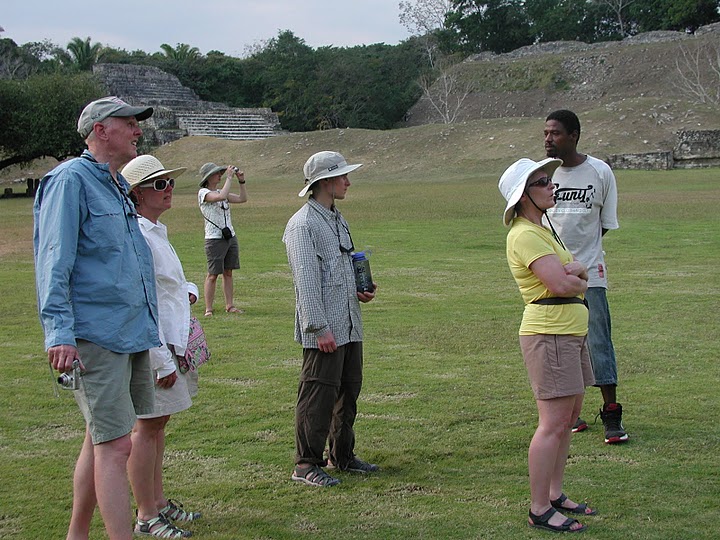
The drive out the Old Northern Highway to Altun Ha was nearly as bumpy as the roads in Yo Creek with the road being more pothole than pavement.  When we arrived we were immediately hit with the heat and humidity.  Luckily the overcast skies offered some relief from the burning sun and an occasional breeze cooled things even more though not a single rain drop fell.  We were immediately approached by a man who introduced himself as John (Juan) who offered his services as a tour guide.  We seemed to be the last tourists of the day as a group of school children were leaving and heading back to their bus.

John was a native of Belize but from the southern area of the Stann Creek District.  He gave us our first real taste of the Creole language.  He told us how he ended up in northern Belize after meeting a girl (of course) who he fell in love with.  Though he was the same age as me, he had three sons the oldest being 12.  He asked me how old I was and I told him that the next day I would be 33.  From that point, the tour was focused around my birthday and getting the perfect photo for me.  Brian was the focus of John's teasing and he took it all in good stride.  We weren't sure how much of what John told us was really accurate but he did offer a very entertaining tour. 

My own research taught me that "Altun Ha" is a modern name in the Maya language, which basically translates to the name of the nearby village of Rockstone Pond. The ancient name is still unknown.  The site covers an area of about 5 square miles. The central square mile of the site has remains of about 500 structures.

Most of the construction took place during the Maya Classic era, c. 200 to 900 AD, when the site may have had a population of about 100,000 people. About 900 AD there was some looting of elite tombs of the site, possibly because of a peasant revolt against the site's rulers. The site remained populated for about another century after that, but with no new major structures built during that time. After this the population dwindled, with a moderate surge of reoccupation in the 20th century before declining again to a small agricultural village.

Stones from the ancient structures were reused for residential construction of the more modern agricultural village of Rockstone Pond, but the ancient site did not come to the attention of archeologists until 1945, when the existence of a sizable ancient site was recognized from the air by pilot and amateur Mayanist Hal Ball.


Starting in 1965 an archeological team lead by Dr. David Pendergast of the Royal Ontario Museum began extensive excavations and restorations of the site, which continued through 1970. Among the discoveries is a large (almost 10 pounds) piece of jade elaborately carved into an image of the head of the Maya sun god, Kinich Ahau. This jade head is considered one of the national treasures of Belize.  Our tour guide, John, claimed to have even been part of an excavation in the 90's.

A climb to the top of the Temple of the Masonry Altars gives an amazing panorama of the site and over the treetops of the jungle. This temple went through eight phases of construction (usually each phase occured when a ruler was interred in the tomb) and the round altar at the top is unique to this site. It was the focus of an unusual sacrificial ceremony in which copal (incense) and beautiful jade carvings were offered into a blazing fire. As far as historians know, there were no human sacrifices at Altun Ha. John insisted that I act out a human sacrifice on Brian just for fun atop the round altar.


One of many structures that has not been fully excavated.


One of four temples that surround the main plaza, from the top of this small temple we had some great views of Plaza A and other structures.


The Temple of the Masonry Altars.


A strangler fig taking over another tree.


A view across Plaza A.


Most of Plaza A with Plaza B in the distance.


Sarah, Brian and Dave with the Temple of the Masonry Altars in the background.


The Browders in Belize.


I will smoosh your head!


Brian


Sarah and Brian


Carvings on the temples depicted Mayan gods.


John told us that he helped to excavated this particular mask in the 90's.


The Temple of the Masonry Altars.


Brian and I at the side of the Temple of the Masonry Altars.


John insisted we "act" like we are happily married.


Looking down from the Temple of the Masonry Altars.


Roger and Janet atop a temple.


John telling us about Altun Ha.


The sacrifice.


He's a goner!


Another of John's photo set-ups.


Side of the Temple of Masonry Altars.


A large tree nearly done in by a strangler fig.


The sunset on the way back to Yo Creek.


Kevin Frasure, Peace Corps Volunteer.


When we arrived back in Yo Creek we met Kevin Frasure who is the current Peace Corps Volunteer in the village (a job George had some 20 years ago).  We learned that Kevin had been in Belize about 7 months and acts as the youth development volunteer at one of the schools in their computer lab.  We also learned that he grew up in Hamilton, Ohio just north of Cincinnati and then lived for five years in Fort Collins, Colorado while he attended Colorado State.  Kevin was great to visit with and filled us in on his experiences in Belize.  It also seemed that he was very excited to have company from the states.  He also really enjoyed dinner that Lorena made for us and told us that villagers have taken him in and often feed him.  You can follow Kevin's adventures in Belize on his blog http://www.frasure7.blogspot.com/ .

Monday, May 10, 2010

Part 8, Caye Ambergris, San Pedro Town

We set out on March 11th from Yo Creek to Belize City where we planned to take the Caye Caulker Water Taxi to Ambergris Caye and the town of San Pedro. Our plan was to arrive early enough in San Pedro to do a little snorkeling and sightseeing then have dinner and spend the night.  We thought we were in good shape since it is only 52 miles from Orange Walk Town to Belize City to get to the water taxi building.  We were even better prepared, so we thought, because we had purchased our water taxi tickets the day before from Antonio at Jungle River Tours.  The drive into Belize City was uneventful but what we were unprepared for was trying to maneuver through the city streets.  It was a spider web of narrow one-way streets, cruise ship passengers ashore for shopping and nowhere to park.  With Dave, Roger, and Brian working together we eventually found the Caye Caulker Water Taxi Building but knew we were too late to catch the 10:00 boat we had hoped to take.  We were relieved to see the parking lot had plenty of space so we unloaded our bags and got ready to go check in.  At the counter the ticket agents were more than slightly worried about the tickets we had purchased elsewhere.  They expressed their concerns that we had been taken and would have to purchase new tickets for all of us.  After several phone calls to be sure our tickets were legit we began to relax more.  When we mentioned to the ticket counter that we would be returning the next day we then learned that the parking lot where we left the van was not for overnight parking and we risked having it damaged if we left it there.  A taxi driver for the Water Taxi Association told Dave we could park it at his home and he would bring it back the next morning.  When Dave prepared to follow the driver across town they decided it would be a better idea to just leave the keys with the taxi driver and he would transport the van across town and back the next morning for us to pick up.  We hoped for the best and knew that it probably wasn't something George and Irma would advise us to do.

While we waited for our 11:30 water taxi to arrive I cracked open lunch from Lorena only to find the most delicious rice dish.  She calls it dirty rice but it is really much more like a fried rice filled with chicken and veggies.  And after a bit we were loaded and off to the island!

Ambergris Caye is the largest island in Belize and the main destination for travellers to the country. San Pedro is the only town on the island. Ambergris Caye has been the center for Belizean area maritime trade for centuries. Originally the focus was more on fishing and coconuts but in the last 30 years it has switched to diving, snorkeling, and ecotourism.

Belize has an amazing coral reef system, the second largest in the world and this hemisphere's longest, running offshore, and many cayes (islands of coral sand) are surrounded by astounding reefs to snorkle or scuba dive. The reef lies one-half mile east of the Ambergris Caye shoreline and runs the entire 25 mile length of the island. This has made San Pedro Town the dive and water sports capital of Belize and Central America.

The Holiday Hotel http://www.sanpedroholiday.com/


After a 90 minute boat ride we arrived in San Pedro and immediately started looking for a place to spend the night.  We ended up at the Holiday Hotel right on the beach.  As we were checking in we inquireda bout getting out for a snorkeling trip that afternoon.  One of the girls at the front desk made a phone call and let us know that the Reef Seeker Glass Bottom Boat typically leaves at 2:00 each day (at that point it was after 2:00) but they didn't have any passengers for the afternoon so they would head our way and be ready for us in the next 30 minutes.  We quickly went to our rooms and changed into swimwear to head out toward the reef. 

Mercedes Valdez and his son arrived at the pier right outside our hotel and promptly headed south toward the reef and the Hol Chan Marine Reserve. Hol Chan is Mayan for 'little channel." This sanctuary was officially established in 1987, and since then the return of all species of fish has been quite dramatic.


Hol Chan Marine Reserve and Shark Ray Alley are approximately 4 miles south of San Pedro Ambergris Caye. It is the single most popular day trip from San Pedro, perfect for snorkeling or diving. The reserve covers approximately three square miles and is divided into three zones. Each one is clearly marked by buoys. The entire reserve focuses on a cut through the reef which is little more than 25 yards wide and 30 feet deep.

The true vacation face!
Brian all geared up and ready to enter the water.
A local sail boat.
One of the local boats.
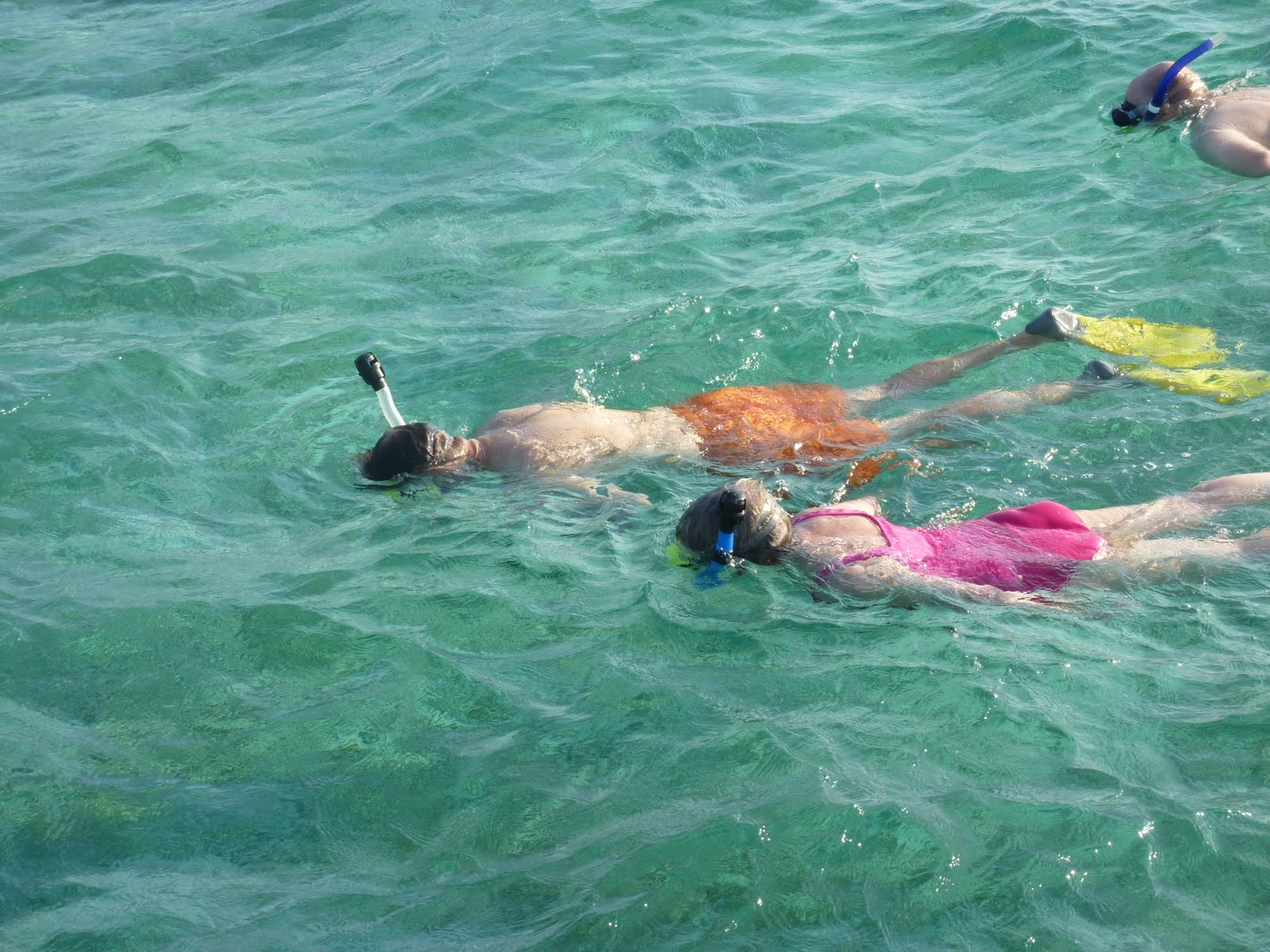
Exploring with snorkels.
Dave and Sarah.

When Mercedes (also known as Mitch) stopped the boat he and his son got us geared up in flippers, masks and snorkels and led us into the shark and ray infested waters.  For Janet and I it was our first experience snorkeling and it was AMAZING!  Huge rays and nurse sharks glided over the sandy bottom.  Schools of tiny colorful fish swam in and out of the coral and conch shells littered the ocean floor.  After quite a while I began feeling woozy and headed back to the boat.  Right about that time, Mitch motioned for all of us to come aboard so we could head to another spot.  I mentioned to Brian my feeling of sea-sickness and he told me it is actually quite common for divers because of the surge of the water.

When the rest of the group promptly splashed back into the sea, I chose to stay on the boat rather than lose my lunch out in the water.  Mitch encouraged me to climb to the top of the glass-bottom boat's flat roof and get a better view.  From there I was able to see everyone following our guide and even saw two huge sea turtles - a green sea turle and a loggerhead which had to be 3 feet across its back.  The cool air definitely made me feel better and soon we were all headed back to San Pedro.  We asked Mitch and his son where to get the best seafood dinner and were told Caramba. 

After getting cleaned up we wandered around the town a bit and asked another person where the best seafood was and again were told Caramba.  So off we went to Pescador Drive to sit and satiate our hunger.
Along the way we were bombarded by street vendors selling their wares - jewelry, cloth, carvings, and so many other things.  Eventually we made it to the restaurant and were greeted by a host who encouraged us to come inside.  When we mentioned that we had been told that this was the best place for seafood he immediately told us that he would bring some complimentary ceviche to us. 

And that ceviche was the best I have ever eaten!  Everyone enjoyed their meals and we also enjoyed trying out a couple other versions of Belikin beer.  www.ambergriscaye.com/caramba

With full bellies and tired bodies we headed back to the Holiday House to be lulled to sleep by the sound of the waves crashing on the shore.

The next morning after a great breakfast at Blue Reef restaurant we picked up where we had left off with our exploration of San Pedro.  We walked through the narrow streets busy with golf carts (the main mode of transportation on the island) and picked up a few things to bring home. 

Roger and Janet at breakfast.


Looking back at the beach from one of the piers.
The streets of San Pedro.
The beaches of San Pedro.
Visiting a local vendor.

Local art at the Blue Reef restaurant.


A quick drink before getting back on the water taxi to Belize City.


When we arrived back in Belize City we were relieved to find our van keys waiting for us at the front desk of the Water Taxi Association office.  We loaded into the van and headed north toward the old highway and the ruins at Altun Ha.

Part 7, The Submerged Crocodile

On March 10th we set out relatively early to catch a boat in Orange Walk Town.  Our destination: the Mayan ruins at Lamanai.  After consulting our guide books we called Antonio Novelo of Jungle River Tours which is owned by Antonio and his two brothers.

Antonio Novelo, our guide to Lamanai


We soon boarded a boat and began our tour on the New River with Antonio and his assistant for the day, Joe.  The boat ride was seventy-five minutes through the northern jungles of Belize where we saw so much wildlife!  Along with the six of us there were four other passengers on our boat including a young man named Christian from Romania, a young woman named Beatriz from Germany, and two French ladies - one who lives in Belize and the other who lives in Florida.  Besides being extensively knowledgeable about the Maya sites, Antonio Novelo is a wildlife expert, and pointed out the lurking crocodiles, iguanas, and dozens of species of birds that you might otherwise miss. The boat also floated past the only operating sugar mill in the country.
 

A tug boat used to move barges near the sugar refinery.


A molasses barge.


Watching for wildlife.


A successful fisherman on the river.


When we arrived at the ruins we promptly found a picnic table to enjoy our lunch made by Antonio's wife.  It was traditional red recado chicken, rice and beans, coleslaw, veggie salad and lemonade.  It was tasty but didn't compare to Lorena's cooking. 
According to Wikipedia...."Lamanai (from Lama'anayin, "submerged crocodile" in Yucatec Maya) is a Mesoamerican archaeological site, and was once a considerably sized city of the Maya civilization, located in the north of Belize, in Orange Walk District. The site's name is pre-Columbian, recorded by early Spanish missionaries, and documented over a millennium earlier in Maya inscriptions as Lam'an'ain.

Lamanai was occupied as early as the 16th century BC.  The site became a prominent centre in the Pre-Classic Period, from the 4th century BC through the 1st century CE. In 625 CE, "Stele 9" was erected there in the Yucatec language of the Maya. Lamanai continued to be occupied up to the 17th century AD. During the Spanish conquest of Yucatán Spanish friars established two Roman Catholic churches here, but a Maya revolt drove the Spanish out. The site was subsequently incorporated by the British in British Honduras, passing with that colony's independence to Belize.

The vast majority of the site remained unexcavated until the mid-1970s. Archaeological work has concentrated on the investigation and restoration of the larger structures, most notably the Mask Temple, Temple of the Jaguar Masks and High Temple. The summit of this latter structure affords a view across the surrounding jungle to a nearby lagoon, part of New River.

A significant portion of the Temple of the Jaguar Masks remains under grassy earth or is covered in dense jungle growth. Unexcavated, it would be significantly taller than the High Temple.

Welcome to Lamanai


A black howler monkey foraging in the trees.


The national flower of Belize....the Black Orchid.


A section of the Mask Temple.


Restoration in progress.


The Mask Temple


The High Temple


The view of the New River Lagoon from the top of the High Temple.


A jungle view from the High Temple.


Coming back down....lots of steps.


Hot and getting tired.


Dave sporting his Indiana Jones look.


Is that Sarah or Jane swinging from a vine?


Stele 9 - the burial place of five royal children.


Temple of the Jaguar Masks.


Temple of the Jaguar Masks.


A courtyard area near the Temple of the Jaguar Masks.


Temple of the Jaguar Masks looking across the nearby courtyard.


The ruins were magnificent and Antonio was the perfect guide.  Belize is a birdwatcher's paradise with over 540 species living in the small country.  With Roger's quick page-turning we were able to identify many animal species. 


This Central American Spider monkey was happy to come aboard our boat and have a snack.


A Morelet's Crocodile.


Our overall wildlife sightings for the day were quite impressive....
Morelet's Crocodile
Common Slider (turtle)
Boa Constrictor (Roger actually touched this guy as it was climbing a tree)
Olivaceous Cormorant
Jabiru Stork (birdwatchers come to Belize specifically to see this bird)
Wood Stork
Boat-Billed heron
Bane-throated Tiger Heron
Little Blue Heron
Tricolored Heron
Great Egret
Snowy Egret
Northern Jacana (these birds walk on top of the floating lily pads and are also called Jesus Christ birds)
Turkey Vulture
Black Vulture
Snail Kite
Black-collared hawk
Yucatan Poorwill
Mangrove Swallow (I loved watching these tiny birds dart above the surface of the water)
Ringed Kingfisher
Belted Kingfisher
Tropical Kingbird
Great Kiskadee
Great-tailed Grackle
Yucatan Black Howler Monkey (when they howl they sound like lions roaring, most groups only see one troop during their visit to the ruins but we saw three different troops)
Central American Spider Monkey
Central American Agouti

Once we returned to the house we were all sunburned, windburned and exhausted.  We ended the day with showers, cold Belikins in the courtyard and chicken, beans and fryjacks made by Lorena for dinner.  Another perfect day!